
 EN
EN
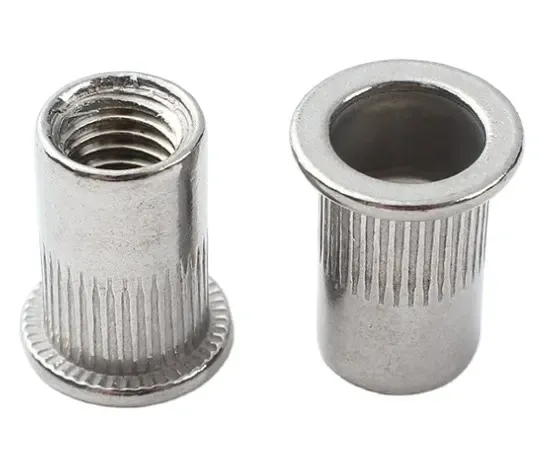
Why Flat Head Knurled Body Rivet Nut Is Engineered for High-Performance Applications
How the flat head profile ensures flush, low-profile integration in sheet metal assemblies
Flat head profiles create a countersunk fit that sits completely inside the material thickness without sticking out on the surface. This makes them work really well with other parts they connect to. They're especially important for things like equipment enclosures, machine frames, and control panels where there's not much room between parts and air flow matters a lot. When these screws are put in correctly, their heads lie right against the surface of whatever they're fastening into, so they don't get in the way of anything moving nearby or bump into other hardware. The wide flat area on top spreads out the pressure from tightening the screw across materials that aren't very thick (3mm or less). This helps spread out the stress instead of concentrating it in one spot, which means less chance of warping the material or having the screw actually pull through the surface over time.
How knurling on the body enhances pull-out resistance and torque retention under dynamic loads
When we talk about circumferential knurling, what happens is that the rivet nut gets transformed into something of a mechanical anchor. During installation process, those raised knurl ridges actually push against and lock into place within the surrounding material, forming small deformation areas that stop things from moving either straight out or spinning around. Some testing done on fastener retention shows these knurled designs can boost resistance against pulling out by as much as 40 percent when compared to regular smooth bodied versions. And here's another thing worth noting: even under constant vibrations or temperature changes, particularly where frequencies go above 500 Hz, those tiny serrations keep holding tight without any risk of threads coming loose. That makes them really good choice for situations involving lots of movement and stress such as vehicles, robotic systems, and various forms of industrial machinery.
Key Customization Parameters for Flat Head Knurled Body Rivet Nut
Adjusting grip range, thread depth, and flange diameter to match material thickness and stack-up
Getting the grip range right for fasteners is critical when it comes to matching them with material thickness so we get even compression across the joint. If there's not enough pressure, joints tend to come loose over time. But go too far with compression and thin materials can actually crack under stress. When dealing with parts that experience a lot of vibration, going beyond standard specs makes sense. Boosting thread depth anywhere from 15 to 30 percent extra keeps those threads engaged properly as things settle in place. The flange size matters too. It needs to stick out past the installation hole somewhere around 2.5 to 3 times bigger than the hole itself. This spreads out the load better, which becomes super important for things like electronics enclosures made from thin sheet metal that's often only about 1.2 mm thick according to what Industrial Fasteners Journal reported back in 2023.
Selecting knurl pitch and height for optimal anchoring in soft vs. hard substrates
The geometry of knurls needs to match up with how hard the substrate material is if we want good mechanical interlock without wrecking the base material. When working with softer stuff like aluminum 5052, going for finer pitch patterns around 45 to 60 teeth per inch makes sense, especially when combined with smaller knurl heights somewhere between 0.2 and 0.3 millimeters. This setup gives better surface coverage and prevents those annoying tears that happen too often. Harder materials present different challenges though. Take A36 steel for instance. Here, operators typically switch to coarser patterns with about 20 to 30 teeth per inch and go for taller knurls measuring 0.3 to 0.5 mm high. These dimensions create stronger interference fits and really boost shear resistance, which matters a lot in industrial applications where parts need to hold together under stress.
| Substrate Hardness | Knurl Pitch (teeth/inch) | Knurl Height (mm) | Performance Benefit |
|---|---|---|---|
| Soft (e.g., Aluminum 5052) | 45–60 | 0.2–0.3 | Prevents material tearing while maintaining >90% torque retention |
| Hard (e.g., Steel A36) | 20–30 | 0.3–0.5 | Enhances pull-out resistance by 40% in high-shear applications |
Material and Coating Selection for Reliable Performance
Avoiding galvanic corrosion: pairing aluminum, stainless steel, or coated flat head knurled body rivet nut with compatible fasteners and base metals
When different metals come into contact in damp, salty, or chemically harsh conditions, galvanic corrosion tends to speed up quite a bit. Stainless steel rivet nuts naturally resist rusting, but problems arise when paired with aluminum unless there's proper electrical separation between them, usually achieved through non-conductive gaskets. The best approach? Match the rivet nut material to whatever metal it's going into. For instance, using aluminum alloy rivets with aluminum parts completely removes those electrochemical issues and makes everything last longer. A big name manufacturer actually saw their marine grade aluminum components last almost 60% longer in the field when they switched to matching materials. Sometimes though, mixing metals just can't be avoided. In those cases, applying zinc-nickel plating or epoxy coatings works pretty well as insulation layers, as long as these coatings meet certain industry standards for environmental exposure and keep the voltage difference below about 0.25 volts.
Matching mechanical properties—yield strength, ductility, and hardness—to substrate (e.g., 5052-H32 aluminum vs. cold-rolled steel)
Getting the mechanical compatibility right between rivet nuts and their substrate material is really important for reliable joints. When working with 5052-H32 aluminum, which we see a lot in aerospace and electronic components, the rivet nuts shouldn't go over 80 HRB hardness. Otherwise, the substrate might start to yield when installing them. On the flip side, those cold rolled or hardened steels rated at 100 HRB or above need fasteners that match or are just a bit harder to maintain proper clamping force especially when there's vibration involved. Matching yield strengths helps prevent early pullouts from happening. And watch out for big differences in ductility too - anything over 15% mismatch tends to crack at the joint interface. For tougher jobs, materials like A286 stainless steel offer great strength without adding much weight plus they handle heat really well. That makes them perfect for aircraft parts and other high temp environments. Just remember to double check specifications before proceeding.
- Thermal expansion coefficient (CTE) compatibility to limit cyclic stress
- Fatigue strength retention at operational temperatures
- Shear strength retention post-installation (target ≥85%)
When to Consider Alternative Head Styles—and Why Flat Head Remains Optimal for Most Custom Applications
Countersunk and reduced head rivet nuts definitely have their place for things like creating ultra flush surfaces on aircraft or fitting into tight spaces inside equipment. But for most structural work, the flat head knurled body version gives engineers exactly what they need. The bigger contact area distributes pressure much better than other options out there, which means less chance of warping materials, parts pulling through, or fasteners coming loose after years of constant vibration. And let's not forget about those knurls on the body itself. They really hold up against both sideways movement and twisting forces no matter if we're working with aluminum sheets, steel plates, or composite panels. That's why specs call for these particular nuts in around 85% of critical applications across manufacturing plants, transport systems, and electronic devices. When companies can't afford failures because of poor connections, these nuts just make sense for keeping everything together reliably without headaches during installation.
FAQ
What is a flat head knurled body rivet nut used for?
Flat head knurled body rivet nuts are used for joining materials where a low-profile, flush surface is needed, such as in aerospace, automotive, and electronic applications. The flat head offers a smooth surface, while knurled sides enhance grip and resistance.
Why are knurled designs preferable over smooth bodied rivet nuts?
Knurled designs provide enhanced resistance to pull-out and torque, particularly under dynamic loads. The knurling creates a mechanical lock with the substrate, improving retention by up to 40% compared to smooth versions.
How can galvanic corrosion be prevented in metal assemblies?
To prevent galvanic corrosion, use compatible metals for rivet nuts and the substrate or apply insulating coatings like zinc-nickel or epoxy. Ensuring electrical separation with a non-conductive gasket can also help when using dissimilar metals.
Table of Contents
- Why Flat Head Knurled Body Rivet Nut Is Engineered for High-Performance Applications
- Key Customization Parameters for Flat Head Knurled Body Rivet Nut
- Material and Coating Selection for Reliable Performance
- When to Consider Alternative Head Styles—and Why Flat Head Remains Optimal for Most Custom Applications
- FAQ