
 EN
EN
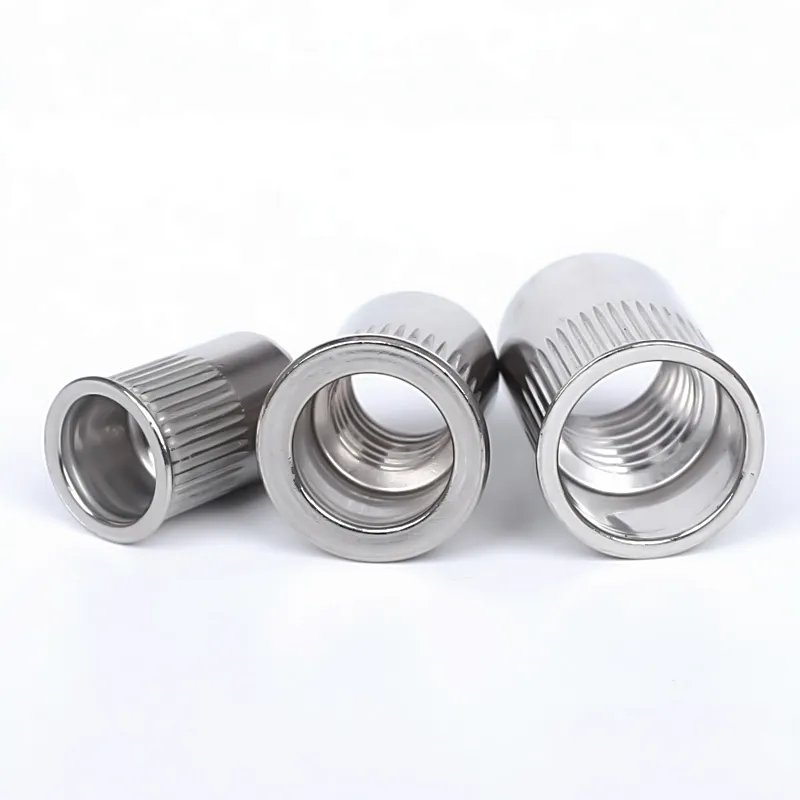
Why Reduce Head Knurled Body Rivet Nuts Deliver Critical Reliability in Demanding Applications
How the Reduced Head + Knurled Body Design Prevents Spin-Out and Ensures Flush, Vibration-Resistant Fastening
The new reduced head knurled body rivet nut combines two clever engineering solutions to tackle those annoying fastening problems that come up in cramped spaces where things get shaken around a lot. The head itself is about 40 percent shorter than regular versions, which means it can sit completely flat against surfaces with really tight clearance gaps, maybe as small as 3 millimeters or so. Think about how useful this would be when installing parts inside airplane cabins or attaching components to car frames. What makes this fastener stand out is its special diamond pattern on the body. When installed, these patterns bite into whatever material they're going into, creating strong mechanical grip that stops them from pulling out. Tests show this actually gives around 30% better hold than similar fasteners with smooth sides. During installation, the fastener doesn't twist out of position because it creates tiny grooves in the surrounding material as it sets in place. These little channels lock everything together without needing just threads to keep things secure. For situations involving constant vibrations, there's another advantage too. Standard rivet nuts tend to lose their tightness over time, but our tests found these new ones maintained their grip with only 10% torque loss after being subjected to five million vibration cycles. And here's something else important: despite their compact size, these fasteners still work well in super thin materials as thin as 0.8 mm without causing any warping or creating stress points that could lead to failure later on.
| Design Feature | Performance Benefit | Industry Application |
|---|---|---|
| Reduced Head Profile | Flush mounting in ≤3mm clearance zones | Aerospace interiors |
| Diamond-Knurled Body | 30% higher pull-out resistance | Automotive subframes |
| Precision Wall Thickness | Zero substrate deformation at 0.8mm thickness | Electronics enclosures |
Key Failure Modes in Thin-Wall & High-Vibration Environments—and Why Standard Rivet Nuts Fall Short
Regular rivet nuts simply don't have the right shape or surface treatment to hold up under tough conditions. When working with thin walls below 1.2 mm thickness, those big heads create leverage problems when installing them. This often warps the surrounding material and starts tiny cracks that become major issues in things like robot joints and electric vehicle battery frames. Vibrations cause mainly two types of problems. First, parts tend to rotate loose over time, accounting for around 68% of all failures according to ASTM standards. Second, there's this microscopic corrosion happening right where the fastener meets the base material. The smooth body versions struggle to keep their grip strength too. Research indicates these can lose nearly half their tightening force after only 500 hours of operation. And if they aren't properly knurled, shear forces at frequencies above 50 Hz will literally spin them out completely. That makes them dangerously unreliable for transport equipment that regularly experiences continuous vibrations throughout normal operations.
Trusted Sources for Reduced Head Knurled Body Rivet Nuts: Authorized Manufacturers and Distributors
Global Leaders: Bollhoff, Sherex, and OptiSert—Certifications, Load Ratings, and ISO 16158 Compliance
Bollhoff, Sherex, and OptiSert have built reputations worldwide for making certified reduced head knurled body rivet nuts that meet ISO 16158 standards. This international spec covers everything from how these blind rivet nuts perform under pressure to their exact dimensions. When it comes to actual testing, the companies put their products through rigorous load checks. Take OptiSert's composite grade models for instance they reach Class 8 thread proof strength by spreading out installation stress over larger areas, which helps protect whatever surface they're attached to. Independent tests show the knurls stay consistent within about plus or minus 0.05 mm depth. That kind of precision matters a lot when working with thin walls where rotation could be a problem. Most authorized suppliers come with complete paperwork including ASTM A563 DH certifications, environmental compliance docs for RoHS and REACH, plus detailed lot tracking records. And some go even further offering special fasteners designed for composites that actually handle vibrations better than what the industry typically expects.
Regional Authorized Distributors (e.g., Rivet Nut USA™): JIT Fulfillment, Batch Traceability, and Technical Support
Companies such as Rivet Nut USA fill an important role connecting strict global manufacturing standards with what local operations actually need on the ground. These distributors stock certified reduced head knurled body rivet nuts across different regions so they can quickly fulfill orders when timing is critical, whether it's fixing aircraft during maintenance or stopping production lines at major auto plants. Every batch comes with full traceability details right out of the box including those serialized lot numbers, records of heat treatment processes, and summary test results needed for compliance with industry standards like AS9100 and PPAP. The technical support staff doesn't just send paperwork either. They offer hands-on installation advice, detailed torque reports, and track parts digitally in real time. This kind of service cuts down waiting periods significantly. Logistics benchmarks from 2023 show lead times drop around 40% when working through these specialized distributors rather than going straight to manufacturers.
5 Non-Negotiable Verification Steps to Ensure Reduced Head Knurled Body Rivet Nut Reliability
Material Certification (ASTM A563 DH, RoHS/REACH), Knurl Depth Tolerance (±0.05 mm), and Third-Party Pull-Out Test Reports
Authenticating reliability demands verification across three foundational criteria:
- Material Certification: Require ASTM A563 DH grade certification for consistent tensile and yield strength—critical for predictable load transfer in thin-wall applications. RoHS and REACH documentation must accompany every shipment to mitigate corrosion risk and ensure regulatory compliance.
- Knurl Depth Precision: Validate knurl depth via calibrated laser measurement to confirm adherence to ±0.05 mm tolerance—non-negotiable for maintaining anti-rotation integrity under sustained vibration.
- Third-Party Load Testing: Insist on ISO 16047-compliant pull-out test reports from ISO/IEC 17025-accredited laboratories, confirming failure thresholds exceed design loads by ≥200% (per ASME B18.15). This margin prevents catastrophic spin-out in high-risk applications such as electric vehicle battery tray assemblies.
Omitting any of these steps significantly increases the risk of fastener disintegration under dynamic loads—where post-failure replacement costs average 5–7× the original installation expense (Fastener Tech International, 2023).
Industry-Specific Sourcing Requirements for Reduced Head Knurled Body Rivet Nuts
Automotive Tier-1: PPAP Documentation and Process Control; Aerospace MRO: NASM/AS9100 Traceability; Industrial Automation: Torque Consistency & Repeatability Testing
When it comes to sourcing materials, companies need to make sure they meet specific quality standards depending on their industry. For automotive Tier-1 suppliers, getting complete PPAP documentation is essential. This includes things like process capability studies where Cp/Cpk needs to be at least 1.33, plus statistical process control data. All this helps ensure consistent product quality when manufacturing runs are large scale. The aerospace maintenance repair overhaul sector has its own set of strict requirements too. Parts need to comply with NASM dimensional specs and follow AS9100 traceability rules. Every batch gets tracked individually through serial numbers linked directly to aircraft certification papers for repairs. Industrial automation folks care deeply about torque consistency. They want certifications showing ±5% tolerance after thousands of cycles, along with testing reports that prove how well components perform in robotic arms dealing with different kinds of forces from various directions. Although industries focus on different types of failures - like preventing parts from pulling out in thin metal car panels or making sure aerospace fuel system components resist corrosion - there's one common thread across all sectors. Third party validation matters most. Companies simply cannot get qualified without those ISO/IEC 17025 accredited test results.
FAQ Section
What makes reduced head knurled body rivet nuts unique?
Reduced head knurled body rivet nuts have a shorter head profile that allows flush mounting in tight clearance areas, complemented by a diamond-knurled body that offers superior grip and resistance to pull-out compared to smooth-sided fasteners.
Why are they important for high-vibration environments?
These rivet nuts are designed to maintain their grip with minimal torque loss even after extensive vibration cycles, making them ideal for use in environments that experience constant vibrations, such as automotive and aerospace applications.
Which industries benefit most from these rivet nuts?
Industries such as aerospace, automotive, and electronics benefit from reduced head knurled body rivet nuts due to their need for reliable, vibration-resistant fastening solutions that prevent spin-out and maintain structural integrity.
How are these rivet nuts tested for reliability?
They undergo rigorous testing including material certification, knurl depth precision validation, and third-party load tests to ensure they meet strict industry standards for performance and regulatory compliance.
Where can I source these rivet nuts?
Authorized manufacturers and distributors like Bollhoff, Sherex, and OptiSert provide certified rivet nuts that adhere to global manufacturing standards, available through regional distributors for quick and reliable delivery.
Table of Contents
- Why Reduce Head Knurled Body Rivet Nuts Deliver Critical Reliability in Demanding Applications
- Trusted Sources for Reduced Head Knurled Body Rivet Nuts: Authorized Manufacturers and Distributors
- 5 Non-Negotiable Verification Steps to Ensure Reduced Head Knurled Body Rivet Nut Reliability
- Industry-Specific Sourcing Requirements for Reduced Head Knurled Body Rivet Nuts