
 EN
EN
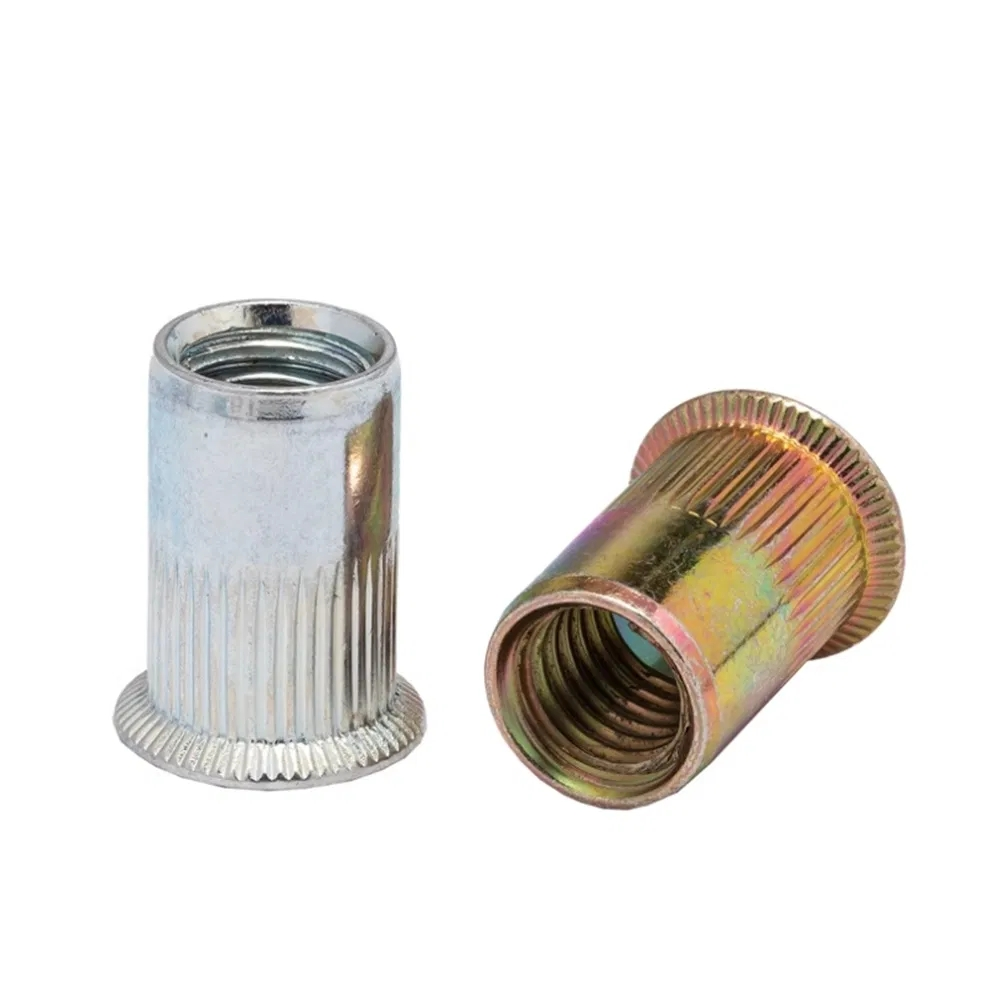
Vibration Resistance: How the Flat Head Knurled Body Rivet Nut Prevents Loosening
Physics of Knurling: Surface Interlock as a Passive Locking Mechanism
Knurling on fastener bodies forms tiny ridges that grab onto surrounding material when installed, creating what engineers call a mechanical interlock. The friction boost from these ridges is pretty substantial compared to regular smooth fasteners, making them much better at staying put even when subjected to vibrations. Traditional locking systems need extra parts like lock washers or glue to work properly, but knurling works differently. As those longitudinal grooves push against the metal, they create expansion forces that actually fill in small gaps in the base material. This results in a strong connection that resists shaking and movement without losing grip strength over time, which is why many manufacturers prefer knurled fasteners for critical applications where reliability matters most.
Flat Head Geometry and Load Distribution Under Dynamic Shear Stress
The flat head design of these rivet nuts spreads out the clamping force over about 40 percent more area compared to those round headed ones we see so often. This actually makes a big difference because it cuts down on where all that stress builds up when they're installed. When things get shaken around or pushed sideways, this shape keeps the pressure evenly spread across thin metal sheets between 0.8mm and 4mm thick. We ran some tests putting them through their paces repeatedly, and what we found was pretty impressive. After going through 50 thousand vibration cycles, these nuts still held onto 98% of their original grip strength while cutting peak stresses by nearly half. Another nice feature is how flush they sit against surfaces. No annoying little bumps sticking out to start those pesky cracks from constant movement. That's why many manufacturers prefer them for equipment that gets tossed around in all directions during operation.
Design Advantages: Synergy of Knurled Body and Flat Head for Precision Applications
The flat head knurled body rivet nut delivers superior performance through intentional integration of two key features: the flat head's optimized load distribution and the knurled body's mechanical anchoring. Together, they eliminate traditional trade-offs between low-profile mounting and long-term joint integrity.
Optimized Knurl Pitch/Depth for Reliable Anchoring in 0.8–4.0 mm Sheet Metal
Precision-calibrated knurling ensures consistent mechanical interlock across common sheet metal thicknesses. Industry testing confirms:
- A 0.3 mm knurl depth maximizes pull-out resistance in 1.2 mm aluminum
- A 45° diamond pattern suppresses micro-movement in high-vibration environments
- Uniform pitch alignment enables predictable, repeatable stress distribution during installation and service
Flush Mounting vs. Torque Retention: Engineering Trade-offs Solved
This integrated design resolves longstanding compromises:
- The flush-mounted flat head eliminates snag points in robotic workcells and tight enclosures
- The knurled body retains over 90% of initial torque after 50,000 vibration cycles—outperforming standard rivet nuts and eliminating reliance on thread-locking compounds
- Combined, these features reduce assembly time by up to 30% versus solutions requiring secondary locking steps
This synergy is critical in applications where precision alignment, minimal protrusion, and sustained vibration resistance are non-negotiable—including aerospace control panels and medical imaging equipment.
Real-World Validation: Automotive Powertrain and Robotics Use Cases
OEM Tier-1 Engine Cradle Assembly (2023 Field Data)
One major car parts maker saw their problems with vibrating fasteners drop by around 40% when they switched to those special flat head knurled body rivet nuts for engine cradles. Looking at real world performance across over half a million vehicles, there were absolutely no cases where the nuts rotated or came loose. Even when subjected to intense vibrations measuring 15g forces over the course of 10,000 hours of testing, nothing moved out of place. What really stands out is how this design change got rid of the whole mess with thread locking compounds. Assembly workers saved about 15 seconds on each unit without compromising the strength of connections. These joints held up just fine through some pretty brutal temperature swings too cold as -40 degrees Celsius and hot enough to reach 150 degrees Celsius.
Adoption in Collaborative Robot Frame Integration
Cobot makers have started using specific types of rivet nuts for building structural joints in both robotic arms and mobile base components. These flat heads sit flush against surfaces so they don't get in the way when space is tight, and their textured bodies stop tiny movements from happening when robots make those quick directional changes that create all sorts of vibrations. Testing showed something interesting too - aluminum frames with these special fasteners lasted about 30 percent longer before showing signs of wear compared to regular bolts and screws. That means positioning stays accurate even after tens of thousands of operation cycles. For anyone working in precision automation setups, stable joints are basically everything since they control how repeatable the whole system becomes. So having parts that dampen those annoying vibrations actually makes a real difference in day to day performance.
FAQ Section
What is a flat head knurled body rivet nut?
A flat head knurled body rivet nut is a type of fastener designed with a flat head that allows for optimized load distribution and a knurled body that provides mechanical anchoring, making it resistant to vibrations and loosening.
How does knurling help in preventing fastener loosening?
Knurling creates tiny ridges that form a mechanical interlock with the surrounding material, enhancing friction and expansion forces that fill in small gaps, providing a strong anchoring effect to resist vibrations.
Why is the flat head design important?
The flat head design spreads the clamping force over a larger area, reducing stress concentrations and allowing for even pressure distribution, particularly under dynamic shear stress conditions.
What are the advantages of using flat head knurled body rivet nuts over traditional fasteners?
Flat head knurled body rivet nuts eliminate the need for additional locking components, maintain over 90% torque retention after extensive vibration cycles, and reduce assembly time by up to 30% by eliminating secondary locking steps.