
 EN
EN
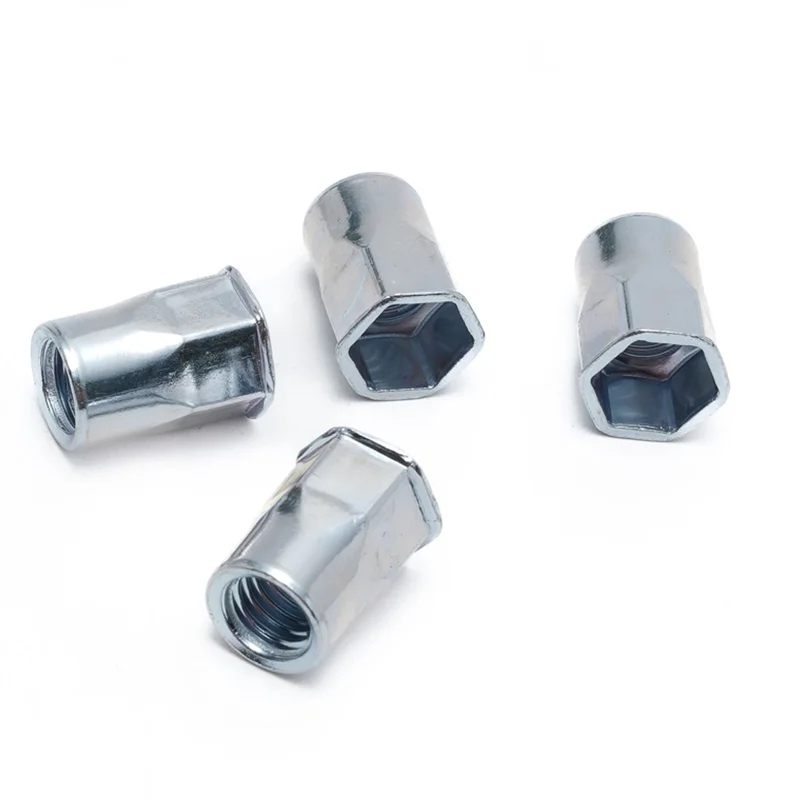
What Is a Reduce Head Half Hex Body Rivet Nut?
Key Design Features: Low-Profile Head and Hexagonal Grip Zone
The new reduced head half hex body rivet nut brings together two key improvements: first, it has a much lower profile head, and second, part of its body is shaped like a hexagon. The head itself is about 40% shorter compared to regular rivet nuts, which means it can be installed flush even in tight spots less than 6mm thick while still maintaining good clamping force. When installed, the half hex shape actually grips into those specially punched hexagonal holes, stopping it from spinning loose when there's lots of torque applied during installation or maintenance work. Real world tests show these nuts save around 30% in weight compared to traditional versions, which makes them really attractive for things like airplanes and electric cars where cutting down on weight helps everything run better. Testing labs have confirmed that the hexagonal section provides solid resistance against rotation forces when the equipment is actually being used in the field.
Why It Excels in Tight-Space and High-Shear Applications
Compared to regular rivet nuts, this fastener works better in tight spaces and situations where things move around a lot. The small head fits right into really thin areas without sticking out, and that special half-hex shape spreads force across six different spots on the material. Tests showed this cuts down stress concentrations by about a quarter in both sheet metal and composite materials according to ASTM standards. For applications such as electric vehicle battery compartments where vibrations are constant, the locking mechanism holds onto most of its initial tightness even after going through temperature changes. Plus, the design can handle slight errors in hole positioning within plus or minus half a millimeter, which makes it great for automated manufacturing processes since there's less need for adjustments later on.
Step-by-Step Installation of the Reduce Head Half Hex Body Rivet Nut
Pre-Installation: Hole Sizing, Material Compatibility, and Alignment Checks
Check the hole diameter with proper calibrated gauges. The tolerance needs to be right on spec from the manufacturer, usually around plus or minus 0.05mm, so the hexagonal parts fit securely together. When it comes to materials, make sure they work well together. Stainless steel rivet nuts go best with aluminum because otherwise there's a risk of galvanic corrosion happening between different metals. For composite materials, always remember to put those special load spreading washers under them to keep from damaging the surface. And don't forget about the angle either. Get out that digital angle finder and check if everything is straight up and down. If things are off by even just 2 degrees, the whole thing starts losing strength against sideways forces.
Setting Process: Tool Engagement, Axial Force Application, and Controlled Deformation
Make sure the mandrel from the setting tool is completely engaged with those internal threads on the rivet nut before proceeding. Apply consistent pressure along the axis, around 1200 to 1500 Newtons works best for the 5mm versions. Keep an eye on the pressure gauge though - don't let it go past 1800 N as that can crack thinner wall materials. The rotational lock typically happens when we reach about 70% compression, after which the head starts to reduce in size in a controlled manner. Once compressed, maintain that final pressure for approximately three seconds to get complete deformation. This ensures the fastener meets the ASTM F2300 standard for pull out strength, usually above 4 kilonewtons in most applications.
Key Execution Notes:
- Material Thickness: Minimum 1.2mm required for consistent, reliable deformation
- Tool Calibration: Validate monthly per ISO 14587 torque standards
- Defect Prevention: Incomplete compression reduces torque retention by up to 8% (Ponemon 2023)
Essential Tools and Settings for Reliable Reduce Head Half Hex Body Rivet Nut Installation
Manual, Pneumatic, and CNC-Compatible Setting Tools
When choosing tools, manufacturers need to consider factors like production volume, required precision levels, and what kind of materials they're working with. For smaller batches, prototypes, or on-site repairs, manual tools are still going strong because they depend so much on the person operating them getting the alignment right and applying just the right amount of pressure. Pneumatic systems take over when speed matters most on assembly lines, capable of delivering those fast installations consistently across thousands of parts. These systems can generate around 2,500 pounds of force which helps ensure every component gets deformed uniformly during production runs. Then there's the CNC compatible equipment that really shines in situations where exact measurements count. With these machines, engineers can program specific parameters down to within about 3% accuracy margin, something that becomes absolutely critical in industries like aerospace where tolerances are razor thin and automotive manufacturing where consistency across millions of vehicles is non-negotiable.
Critical setup parameters include:
- Force settings matched to material thickness (e.g., 0.8–1.2 kN for 1mm aluminum)
- Mandrel alignment within 2° of perpendicular to engage the hex body correctly
- Stroke length preset to avoid under- or over-compression
Underpowered tools risk incomplete flange formation; excessive force distorts the low-profile head. Certified load-cell verification between calibrations ensures ongoing reliability—especially where torque retention above 12 N·m is mission-critical.
Verification, Testing, and Quality Assurance
Pull-Out Resistance, Torque Retention, and Compliance with ASTM F2300/ISO 14587
The verification process starts off with standard pull out tests that measure how much axial load something can handle when subjected to simulated vibrations or other dynamic stresses. After this initial check comes the torque retention evaluation which looks at how well components resist rotation over time. Meeting ASTM F2300 requirements covers things like mechanical strength and proper installation while ISO 14587 deals specifically with keeping torque levels consistent along with maintaining adequate clamping forces. These industry standards actually serve as pretty good indicators of whether materials will hold up, deform properly, and produce repeatable results across different batches. When manufacturers get third party validation against these specs, they see around a 32 percent drop in field failures compared to those who skip formal certification according to recent findings published in Manufacturing Safety Journal last year.
FAQ
What are the key benefits of using a reduced head half hex body rivet nut?
This type of rivet nut offers weight savings, enhanced clamping force, resistance to rotation, and suitability for installation in tight spaces.
How is the installation process unique for these rivet nuts compared to regular ones?
The installation involves unique considerations such as using hexagonal shaped holes for grip, precise force application, and verified deformation, enhancing the fastener's reliability.
Are there specific tools required for installing these rivet nuts?
Yes, installation can involve manual, pneumatic, or CNC-compatible setting tools, with settings tailored to the material thickness and installation requirements.
What standards are these rivet nuts tested against?
They are tested against ASTM F2300 and ISO 14587 standards to ensure performance in terms of pull-out resistance and torque retention.