
 EN
EN
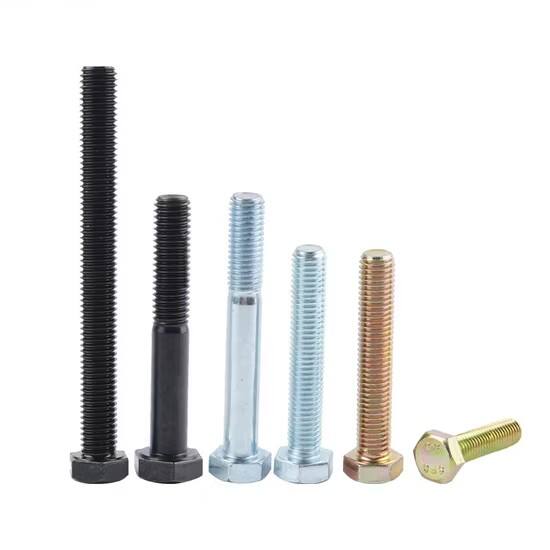
Hexagonal Head Bolt Grades Explained: Strength, Standards, and Markings
Understanding the different grades of a hexagonal head bolt is the first step toward selecting the right fastener for any application. Engineers must navigate two primary classification systems: the metric property class system and the SAE grade system. Each uses distinct head markings and adheres to specific standards—linking the bolt’s visual identity directly to its mechanical performance.
Decoding Metric Property Classes (8.8, 10.9, 12.9) and SAE Grades (2, 5, 8)
The metric system uses property classes such as 8.8, 10.9, and 12.9, while the SAE system relies on grades like 2, 5, and 8. The chart below compares their key specifications to help you make informed engineering choices.
| System | Grade / Class | Head Marking | Tensile Strength (MPa) | Tensile Strength (psi) |
|---|---|---|---|---|
| SAE | Grade 2 | No Markings | 600 | 74,000 |
| SAE | Grade 5 | 3 Radial Lines | 827 | 120,000 |
| SAE | Grade 8 | 6 Radial Lines | 1034 | 150,000 |
| Metric | Class 8.8 | < 16mm: 8.8 | 800 | 116,000 |
| Metric | Class 10.9 | 10.9 | 1040 | 150,800 |
| Metric | Class 12.9 | 12.9 | 1220 | 176,900 |
These grades represent a clear progression in strength. A Grade 5 hexagonal head bolt is significantly stronger than a Grade 2, and a Class 12.9 metric bolt stands among the strongest common fasteners available.
Key Mechanical Properties: Tensile Strength, Yield Strength, and Proof Load
Three core metrics define the performance of any grade. Tensile strength is the maximum load a bolt can withstand before fracturing. Yield strength indicates the stress level at which permanent deformation begins. Proof load, defined in ISO 898-1 and SAE J429, is a non-destructive test load the bolt must endure without permanent set.
A higher proof load enables greater preload in clamped joints—critical for fatigue resistance and joint stiffness. For example, a Class 10.9 bolt achieves up to 90% of its yield strength as usable preload, compared with ~75% for Class 8.8.
| Property | SAE Grade 2 | SAE Grade 5 | Metric Class 8.8 | Metric Class 10.9 |
|---|---|---|---|---|
| Min. Yield (psi / MPa) | 57,000 / 393 | 92,000 / 634 | 93,200 / 640 | 136,300 / 940 |
| Min. Tensile (psi / MPa) | 74,000 / 510 | 120,000 / 827 | 116,000 / 800 | 150,800 / 1040 |
Note: Yield values for SAE Grade 5 and Metric Class 8.8/10.9 are standardized per SAE J429 and ISO 898-1 respectively; MPa conversions reflect typical minimums.
How Head Markings and Standards (ISO 898-1, SAE J429, ASTM A325/A490) Identify Hexagonal Head Bolt Grade
You can instantly identify a hexagonal head bolt's grade by examining its head markings. SAE Grade 5 bolts display three radial lines, while Grade 8 bolts show six. Metric bolts are typically stamped with their class number, such as "8.8" or "10.9." Stainless steel hardware often carries marks like "A-2" or "A-4."
These markings align with globally recognized standards:
- ISO 898-1 governs carbon and alloy steel metric bolts (Classes 4.6 to 12.9), specifying mechanical properties, testing methods, and marking requirements.
- SAE J429 covers inch-series bolts (Grades 2, 5, and 8), defining tensile/yield limits, hardness, and head marking conventions.
- ASTM A325 and A490 apply specifically to structural bolts used in steel-frame construction—requiring additional testing for toughness, heat treatment verification, and consistent thread engagement.
Trusting a bolt’s grade based solely on appearance is risky. Always verify head markings against the applicable standard—especially when sourcing from multiple suppliers—to ensure mechanical properties meet your design’s safety and service-life requirements.
Selecting the Optimal Hexagonal Head Bolt Grade by Application Demand
High-Load Structural Applications: Why Class 10.9 and ASTM A325 Dominate Bridges and Steel Frames
In bridges and steel frames, static and cyclic loads demand exceptional tensile and yield strength. Class 10.9 metric bolts—with a minimum tensile strength of 1040 MPa and yield strength of 940 MPa—resist permanent deformation under sustained stress. ASTM A325 structural bolts, widely used in North American steel construction, provide a reliable 120 ksi (827 MPa) minimum tensile strength and pass rigorous Charpy impact tests at low temperatures.
Both grades deliver high clamp loads that minimize joint slip in large assemblies. Crucially, they maintain controlled ductility during installation—reducing the risk of brittle fracture when tightened to specification torque. For steel beam connections, tower bases, and highway bridges, selecting a proven high-strength grade directly improves safety margins and extends service life.
Dynamic & Vibration-Prone Environments: Prioritizing Ductility and Fatigue Resistance in Automotive and Machinery
When a hexagonal head bolt faces cyclic vibrations, shock loads, or thermal cycling, ductility becomes as critical as raw strength. Automotive chassis, engine mounts, and industrial gearboxes often specify Class 8.8 or 10.9 bolts with controlled hardness and elongation (12–9%) to absorb repeated stress without cracking.
These grades strike an optimal balance between tensile strength (800–1040 MPa) and plastic deformation capacity—allowing slight yielding before failure. For high-cycle fatigue applications, engineers further enhance reliability by specifying rolled threads (which improve surface integrity) and fine-pitch threads (to reduce stress concentration). Pairing these bolts with matching nut grades (e.g., Class 10 nuts for Class 10.9 bolts) and hardened washers helps preserve preload over time—preventing loosening and extending maintenance intervals.
Avoiding Critical Compatibility Failures with Hexagonal Head Bolt Grade Matching
Nut and Washer Grade Alignment: Preventing Under-Torqued Joints or Brittle Fracture
A hexagonal head bolt joint is only as strong as its weakest component. Mismatched nuts or washers introduce two critical failure modes: under-torqued joints and brittle fracture. When a nut is softer than the bolt, it may strip threads before the bolt reaches target preload. Conversely, an overly hard nut can cause the bolt’s threads to shear.
For metric systems, a Class 10.9 bolt requires a Class 10 nut per ISO 898-2—using a Class 8 nut degrades joint strength by up to 25%. In SAE applications, a Grade 8 bolt must be paired with a Grade C or DH nut per ASTM A563. Washer hardness matters too: soft washers can embed under heavy loads, reducing effective clamp force and accelerating loosening.
Top 3 Grade Selection Mistakes—Especially Risky Substitutions in Safety-Critical Hexagonal Head Bolt Assemblies
Three common errors dominate field failures:
(1) Substituting a lower-grade bolt for convenience—assuming visual similarity implies functional equivalence;
(2) Mixing metric property classes with imperial SAE grades without verifying mechanical equivalency using authoritative conversion resources like ISO/TR 16842 or ASTM F2281;
(3) Reusing bolts previously stretched beyond yield—a practice that compromises preload retention and fatigue life.
In safety-critical assemblies—such as lifting points, brake caliper mounts, or structural steel connections—these mistakes can trigger sudden, catastrophic joint failure. Always verify head markings against the specified standard, consult original equipment or design documentation, and never substitute without formal engineering review.
FAQ
- What do the numbers on a hexagonal head bolt mean? The numbers or markings indicate the bolt's grade or class, which represents its mechanical properties like tensile strength, yield strength, and proof load. For example, metric bolts use a class system such as 8.8, 10.9, or 12.9, while SAE bolts use grade markings like Grade 2, 5, or 8.
- How can I identify the grade of a hexagonal head bolt? Examine the head markings—SAE bolts have radial lines (e.g., three lines for Grade 5, six for Grade 8), while metric bolts are marked with class numbers (e.g., 8.8, 10.9).
- Why is it important to match nut and washer grades with the bolt grade? Mismatched grades can weaken the joint. Softer nuts may strip threads before reaching the target torque, while overly hard nuts can cause thread shearing.
- What are the risks of using the wrong bolt grade in safety-critical applications? Substituting a lower-grade bolt, mixing metric and SAE specifications without verifying equivalency, or reusing over-yielded bolts can result in premature joint failure, loss of preload, and catastrophic breakage.
- What standards govern the mechanical properties and markings of hexagonal head bolts? Standards like ISO 898-1, SAE J429, and ASTM A325/A490 ensure bolts meet specific mechanical properties, testing, and marking requirements, providing reliability and safety for various applications.