
 EN
EN
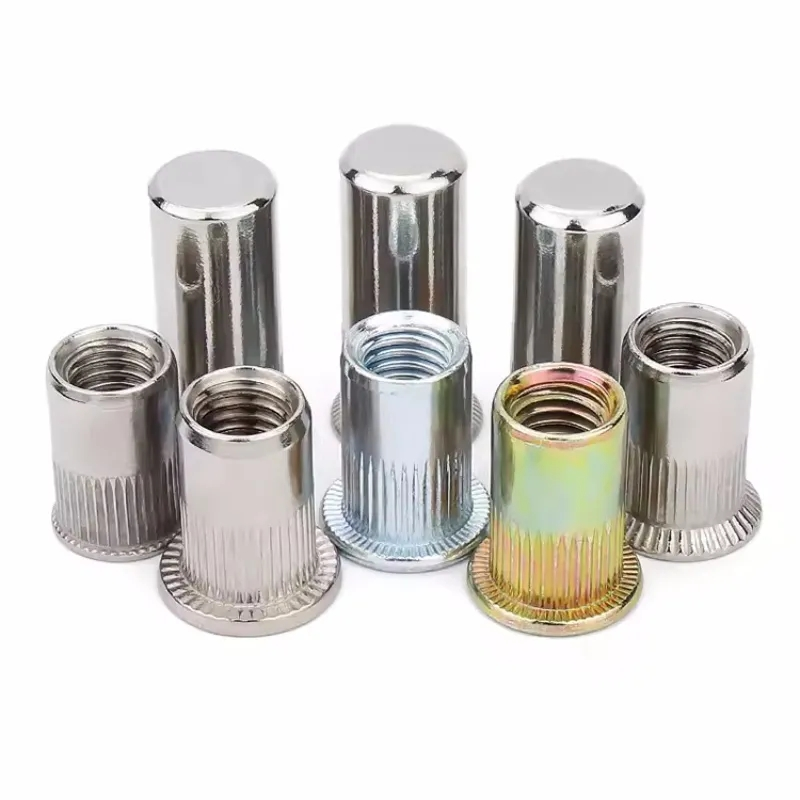
Rivet Nut Types and Design Features for Steel Office Furniture
Selecting optimal rivet nut designs ensures structural integrity in office furniture where steel substrates endure daily stress cycles. Choices balance anti-rotation performance, material compatibility, and installation constraints.
Full-hex, half-hex, and Xtralok® rivet nuts: Performance and application differences
Full hex nuts offer significantly better torque resistance compared to their round body counterparts, with tests showing around 40% improvement. This makes them great choices for stress points such as chair base connections and structural beam assemblies. For applications that don't require extreme strength, half hex versions strike a good balance between holding power and affordability. They work well on decorative panels or other areas where appearance matters more than absolute strength. Xtralok's special segmented mandrel design allows these fasteners to expand evenly when installed in thin sheet metal up to 1.5mm thick. Independent lab results from last year indicate this tech cuts down on those annoying spin out failures by about 22%, which is pretty impressive for something so small.
Bulging vs. non-bulging designs: Impact on thin and tubular steel frames
When installed, bulging rivet nuts actually deform outward, creating compression that boosts pull out strength around 30% according to Ponemon's research from last year. They also spread the load better on those thin materials between 0.8 and 2 millimeters thick, which helps reduce warping issues at the welded corners of structures. On the flip side, non-bulging versions work great for solid steel parts but can cause problems with tubes when subjected to repeated loading cycles. These require very precise hole tolerances, within plus or minus 0.1 millimeter really, otherwise the clamping force drops off and things start coming loose over time.
Flange design: How large flange and low-profile variants affect load distribution
Flange dimensions directly influence stress dispersion and interface compatibility:
- Large flanges (6–12mm diameter) reduce surface pressure by 45% on particleboard attachments—critical for hybrid steel-wood desk assemblies
- Low-profile designs enable flush mounting in visible areas while retaining 80% of standard flange tensile strength
Selection should align with primary load direction:
| Flange Type | Shear Strength | Tensile Strength | Clearance Needed |
|---|---|---|---|
| Large | High | Moderate | 3–5mm |
| Low-profile | Moderate | High | ≤1mm |
ASTM F1367 confirms wide flanges outperform narrow variants in shear-dominant applications—such as desk leg-to-frame connections—where lateral stability is essential.
Material Selection and Mechanical Performance Requirements
Matching rivet nut materials (steel, stainless steel, aluminum) to steel furniture substrates
Material compatibility prevents galvanic corrosion and preserves long-term joint integrity:
- Carbon steel rivet nuts: Cost-effective for dry, indoor environments; require zinc or trivalent chromium plating when relative humidity exceeds 60% RH
- Stainless steel variants (e.g., AISI 304/316): Necessary for coastal, high-moisture, or sterilizable settings due to self-repairing chromium oxide layers
- Aluminum alloys (e.g., 5052, 6061): Preferred for lightweight components; anodizing is recommended when joining dissimilar metals to inhibit electrochemical degradation
Key performance metrics: Pull-out strength, torque resistance, and spin-out prevention
Three mechanical properties define reliability in dynamic furniture assemblies:
- Pull-out strength must meet or exceed 2,500 lbf for load-bearing frames—validated per ASTM F467—to withstand vertical stresses from repeated seating, tilting, or stacking
- Torque resistance above 12 N·m ensures fasteners resist vibration-induced loosening in modular, reconfigurable systems
- Spin-out prevention, achieved via knurled collars or hexagonal bodies, is especially critical in thin-gauge steel (<3mm), where substrate bite depth determines joint longevity
Thread Size, Grip Range, and Hole Tolerance for Variable Steel Thicknesses
Selecting thread size based on load-bearing requirements of office furniture
Choosing the right thread size isn't about what's easiest to work with but what actually works for the job at hand. For lighter stuff like panel trims on backs of chairs, small threads such as M4 or #6-32 generally do the trick. But when dealing with heavy duty connections that need to hold more than 1000 pounds, bigger options like M10 or 1/4-20 become necessary. Going too small can lead to serious problems when things get shaken up or loaded down beyond their capacity. We're talking failures happening when weights hit around 740 pounds during normal movements like opening drawers or tilting cabinets (Ponemon 2023). Keep these considerations in mind when making selections for different applications.
- Low-load applications: #6-32 for decorative trim or cable management brackets
- Medium-duty: 1/4-20 for monitor arms or adjustable shelf supports
- Heavy structural: 3/8-16 for cantilevered desk frames or ergonomic chair mechanisms
Optimizing grip range and hole tolerance with Plus Nuts and Xtralok® for precision fits
Rivet nuts designed for specific applications handle steel thicknesses ranging between 0.010 inches and 0.500 inches without affecting their performance. The Plus Nut version works great when dealing with uneven or warped materials because it has a longer grip range. Xtralok features a segmented mandrel that expands evenly across all surfaces, even on thin gauge steel, without putting too much pressure on the material itself. Keeping holes within about plus or minus 0.002 inches helps maintain strong pull out resistance, especially important for those tubular frames that experience side loading forces. When installed properly, these fasteners create consistent clamping power, stop tiny movements in parts that stick out from supports, and actually cut down vibrations by around 30 percent in furniture meant for moving environments.
Blind Installation in Enclosed Steel Furniture Frames
Advantages of blind rivet nuts in tubular and welded steel structures
Blind rivet nuts tackle what's become a real headache for makers of office furniture these days. When putting together those closed off steel frames that are either tubular or completely welded shut, getting to the back side just isn't possible. These little fasteners let workers install them securely from one side only, which comes in handy in tight spots like chair legs, cross beams, and those pedestal bases we see everywhere now. What makes them special is how they expand when set, gripping materials as thin as half a millimeter without messing up their shape. This means no damage to those nice powder coat finishes either. And here's another plus point compared to welding: no worrying about heat damaging areas around the joint, no risk of things warping out of shape, plus everything stays put but can still come apart later if needed. That matters a lot for fixing stuff down the road, keeping things green, and meeting those circular design standards companies are supposed to follow nowadays.
Installation best practices for thin-walled and hard-to-reach areas
Successful blind installation in constrained geometries requires calibrated tooling and disciplined technique:
- For steel under 1.2mm, use low-force mandrels to avoid bulging while ensuring full thread engagement
- Position tools perpendicular to the surface—especially near welded seams—to prevent cross-threading and mandrel breakage
- Pre-test hole diameters in tubular frames using gauge pins (±0.1mm tolerance) to confirm fit before production runs
- Validate initial samples with pull-testing per ASTM F467 to verify load-bearing capacity meets design specifications
FAQ
What are the advantages of full-hex rivet nuts over round counterparts?
Full-hex rivet nuts provide better torque resistance compared to round body versions, making them ideal for stress points such as chair bases and structural beams.
When should I use bulging vs. non-bulging rivet nuts?
Bulging rivet nuts are best for thin materials (0.8-2mm) as they boost pull-out strength and reduce warping. Non-bulging versions suit solid parts but need precise hole tolerances.
Why choose large flange rivet nuts?
Large flange rivet nuts offer better stress dispersion, essential in hybrid steel-wood furniture, and are suited for shear-dominant connections like desk frames.
Which materials are suitable for different environmental conditions?
Carbon steel rivet nuts are for dry indoor use, stainless steel for high-moisture or coastal areas due to corrosion resistance, and aluminum alloys for lightweight needs.
Why are blind rivet nuts preferred in tubular structures?
Blind rivet nuts allow for one-sided installation in closed steel frames, preventing heat damage and warping, and maintain joint integrity for repair and sustainability.