
 EN
EN
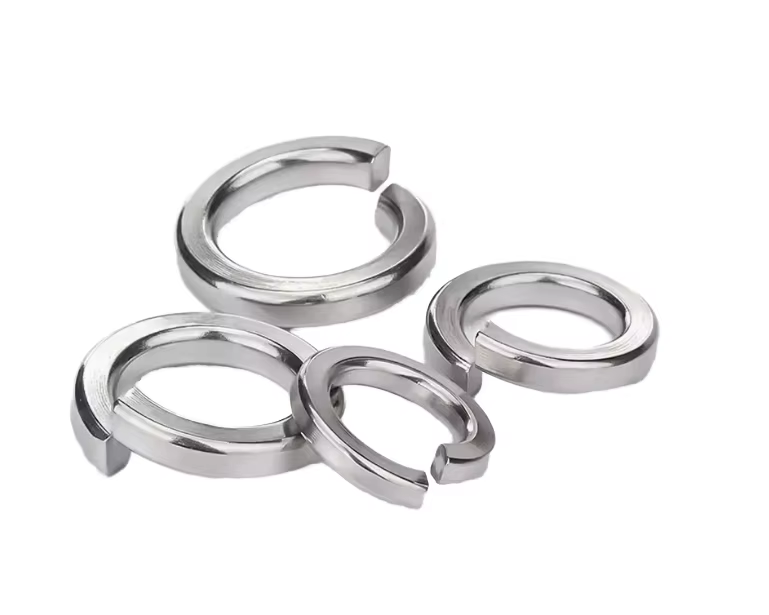
Load Distribution and Surface Protection: Preventing Joint Failure
How washers reduce bearing stress and prevent surface deformation under bolt preload
Industrial washers transform concentrated bolt forces into distributed loads across mating surfaces. When bolts generate preload torque, stress peaks emerge at fastener contact points—often exceeding the yield strength of softer materials like aluminum or composites. A properly sized steel washer increases bearing area by 300–500%, spreading clamp forces and reducing interface pressure. This mechanical buffering prevents localized yielding, creep deformation, and joint relaxation. In cast iron components, for example, washers eliminate micro-cracking at fastener seats by keeping compressive stresses below 50% of the material’s ultimate strength. Washers also serve as sacrificial barriers during thermal cycling or vibration, absorbing micro-movements that would otherwise degrade parent material integrity through fretting wear.
Empirical validation: Up to 40% bearing stress reduction with hardened steel washers (SAE J429)
SAE J429 testing confirms hardened steel washers reduce bearing stress by up to 40% compared to direct bolt-to-joint interfaces. Controlled torque-tension studies using 10mm ASTM A574 bolts showed maximum stress reduction when paired with washers meeting a minimum hardness of 45 HRC—a threshold aligned with optimal load distribution performance. Field data from industrial machinery assemblies correlate with these findings, showing a 70% decrease in surface deformation incidents where hardened washers were implemented. Stress-reduction efficiency follows a logarithmic relationship with washer thickness: 2mm variants deliver 80% of the benefit achievable with thicker designs—making them a weight- and cost-efficient choice. Critically, the test methodology isolates washer performance by controlling for confounding variables such as thread friction and lubrication variances.
Vibration Resistance and Clamp Force Retention
Elastic recovery and micro-slip suppression in spring-type washers
Spring-type washers store elastic energy during compression and rebound dynamically under cyclic loading, counteracting vibrational forces that cause bolt rotation. As transverse movements occur, the washer redistributes displacement energy—suppressing micro-slip at the joint interface, the primary trigger for self-loosening. Field studies demonstrate properly specified spring washers reduce clamp force loss by up to 40% in vibrating machinery, per SAE 2023 guidelines.
The stiffness paradox: Why excessive washer rigidity can accelerate loosening in cyclic loading
Counterintuitively, ultra-rigid washers can worsen vibration-induced failures through three mechanisms:
- Embedding acceleration: Hardened surfaces concentrate stress, promoting localized plastic deformation in softer joint materials
- Resonance amplification: Inelastic materials transfer harmonic vibrations rather than absorbing them
- Friction reduction: Diminished elastic recovery limits micro-slip resistance
This paradox underscores the need for material-specific stiffness selection—corrosion-resistant alloys perform best with moderate hardness, while polymer composites require lower-modulus washers to avoid damage.
Loosening Prevention: Lock Washer Types and Functional Mechanisms
Lock washers counteract fastener loosening caused by vibration, thermal cycling, and dynamic loads through specialized mechanical designs. Split lock washers use helical cuts to generate spring tension that maintains clamp force; tooth lock washers employ internal or external serrations that bite into mating surfaces to resist rotation; and wedge lock washers—used in opposing pairs—create increasing axial tension if rotation begins, enabling self-tightening under vibrational stress. In aerospace applications, tab washers physically block rotation by bending tabs against fastener heads, though they complicate disassembly.
Belleville (conical) spring washers absorb shock through controlled deflection but offer limited high-frequency vibration resistance without supplemental locking. Tooth-type designs risk surface damage in soft materials, potentially compromising fatigue life. Recent innovations include multi-layer spring washers that optimize load distribution and polymer-embedded variants combining vibration damping with galvanic isolation.
When selecting lock washers, consider functional trade-offs: wedge types provide superior vibration resistance—ASTM F1941 tests show ±70% higher clamp retention than split washers—but carry higher cost and assembly complexity. Split washers remain a reliable, economical solution for moderate-load applications.
Environmental Protection: Corrosion Control, Electrical Isolation, and Material Compatibility
Polymer and coated washers for galvanic isolation in mixed-metal assemblies (e.g., aluminum-steel)
Washers prevent electrochemical degradation in dissimilar-metal joints. In aluminum-steel assemblies, uninsulated contact forms a galvanic cell where steel corrodes up to five times faster than aluminum due to voltage potential differences. Polymer or epoxy-coated washers act as dielectric barriers, halting ion transfer between metals. Salt-spray testing (ASTM B117) shows such isolation reduces corrosion rates by up to 90%. For marine hardware and other critical applications, nylon washers provide electrical resistance exceeding 10¹⁵ Ω·cm while maintaining functional clamp loads. Material compatibility extends beyond isolation: PTFE variants resist aggressive chemical exposure, and silicone coatings accommodate thermal expansion mismatches. Proper washer selection eliminates costly failures from galvanic pitting in mixed-metal assemblies.
FAQ
What is the main purpose of using washers in bolt assemblies?
Washers primarily distribute loads from bolts across mating surfaces, reducing bearing stresses and preventing surface deformation. Additionally, they serve various roles such as vibration resistance, loosening prevention, and environmental protection.
How do hardened steel washers reduce bearing stress?
SAE J429 testing has shown that hardened steel washers can reduce bearing stress by up to 40% compared to direct bolt-to-joint interfaces. This is achieved by increasing the bearing area and spreading clamp forces, thus reducing interface pressure.
What type of material works best with spring-type washers?
Spring-type washers perform best in applications requiring elastic recovery and micro-slip suppression, particularly in vibrating machinery. Choosing the right material depends on the application, with corrosion-resistant alloys and polymer composites being ideal for different conditions.
How do lock washers prevent fastener loosening?
Lock washers utilize specialized mechanical designs to counteract fastener loosening due to vibration, thermal cycling, and dynamic loads. Different types like split, tooth, and wedge lock washers use varied mechanisms such as spring tension, serrations, and axial tension to maintain clamp force.
Why is galvanic isolation important in mixed-metal assemblies?
Galvanic isolation is crucial because uninsulated metal contact can cause electrochemical degradation, where one metal corrodes faster than another. Polymer and coated washers act as dielectric barriers, preventing ion transfer and reducing corrosion rates significantly.