
 EN
EN
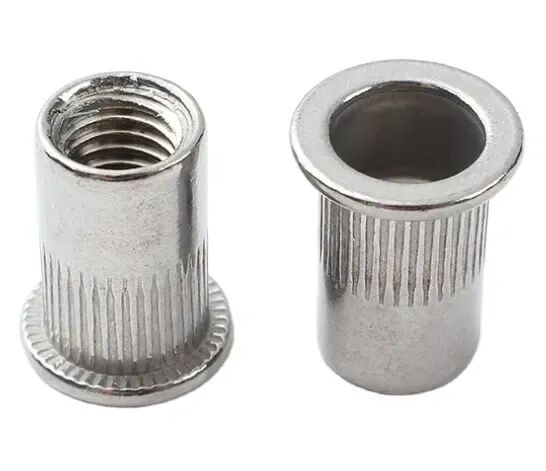
Mechanical Performance Requirements for Rivet Nut Applications
Torque-Out, Pull-Out, and Clamp Load Optimization by Rivet Nut Material
Material selection directly governs rivet nut performance in industrial assemblies. Stainless steel variants withstand nearly triple the pull-out force of aluminum equivalents at M6 sizes (7.5–10 kN vs. 2.5–4 kN). Carbon steel offers intermediate strength but requires protective coatings to prevent corrosion. Clamp load retention after thermal cycling differs markedly: aluminum maintains 70–80% of initial tension, while stainless steel retains 90–95%—a distinction validated under ASTM F2282 testing protocols. Installation torque ranges reflect these differences—aluminum M8 nuts require only 5–7 N·m, whereas stainless steel demands 15–20 N·m. These mechanical profiles determine suitability across applications, from aircraft skins demanding high clamp retention to automotive subframes requiring balanced strength and weight.
The Strength-Reliability Paradox: Why Higher-Strength Rivet Nuts Can Compromise Joint Integrity in Lightweight Assemblies
Higher-strength materials can undermine joint integrity when paired with thin or composite substrates. Stainless steel’s tensile strength (up to 520 MPa) may deform 0.8 mm aluminum sheets during installation—a risk avoided by using aluminum rivet nuts, which better match substrate ductility. This paradox is most evident under cyclic loading: while high-strength fasteners retain their own integrity, they concentrate stress at the joint interface, accelerating fatigue in weaker joined materials. Vibration testing shows aluminum rivet nuts in 1 mm steel panels withstand 50% more cycles before loosening than stainless steel alternatives. Engineers must therefore prioritize substrate compatibility over raw fastener strength—especially in transportation, electronics enclosures, and other lightweight systems where joint reliability hinges on balanced mechanical response.
Corrosion Resistance and Surface Treatment Strategies for Rivet Nuts
Zinc Plating, Passivation, and Alternative Coatings to Prevent Galvanic Corrosion in Rivet Nut Installations
Galvanic corrosion accelerates when dissimilar metals contact electrolytes such as saltwater or industrial chemicals. Surface treatments serve as essential barriers: zinc plating provides sacrificial protection for carbon steel rivet nuts, typically achieving 72–120 hours of neutral salt spray (NSS) resistance per ASTM B117. Passivation enhances stainless steel’s natural chromium oxide layer, improving chemical resistance without adding thickness. For extreme environments, Dacromet zinc-aluminum flake coatings deliver ≥500 hours NSS protection—five times that of standard zinc. Aluminum rivet nuts rely on anodizing to thicken their self-healing oxide layer (2–5 μm), while nickel plating supports applications requiring electrical conductivity and ≥96-hour NSS resistance.
| Coating Type | NSS Resistance (Hours) | Ideal Application |
|---|---|---|
| Zinc Plating | 72–120 | Indoor/mild outdoor |
| Dacromet | ≥500 | Marine/offshore |
| Nickel Plating | ≥96 | Electrical/chemical |
| Anodized Aluminum | Self-healing oxide | Aerospace/electronics |
Electrochemical Series Alignment: Matching Rivet Nut Material to Substrate to Minimize Galvanic Risk
Material compatibility depends on electrochemical potential gaps—measured in volts—between rivet nuts and substrates. Pairing metals within ≤0.15 V (e.g., aluminum rivet nuts with aluminum panels) minimizes galvanic current flow. In contrast, carbon steel rivet nuts (+0.85 V) installed in copper substrates (−0.34 V) create a 1.19 V differential that accelerates corrosion eightfold compared to aligned pairs. For unavoidable mismatches, dielectric sealants or nylon washers effectively insulate contact points. In marine projects, 316 stainless steel rivet nuts align closely with nickel alloys (ΔV = 0.05 V), reducing failure rates by 70% versus carbon steel alternatives in salt spray testing (ASTM B117).
Substrate-Specific Rivet Nut Material Compatibility
Aluminum, Stainless Steel, Composites, and Plastics: Thermal Expansion, Creep, and Installation Behavior
Selecting the right rivet nut material requires matching key physical properties to the substrate to prevent joint failure. Aluminum rivet nuts in aluminum assemblies eliminate galvanic risk but must account for thermal expansion mismatch—aluminum expands 50% more than steel at 100°C (ASTM E228-11). In stainless steel substrates, steel rivet nuts provide strength alignment but risk crevice corrosion unless passivated. Polymer and composite substrates introduce unique constraints: thermoplastics undergo creep deformation under sustained clamp loads, while CFRPs (Carbon Fiber Reinforced Polymers) require installation forces below 3 kN to avoid delamination (CAMX 2022). Installation temperature also affects performance; below 0°C, aluminum rivet nuts in plastics risk brittle fracture due to reduced ductility. Matching thermal expansion rates prevents loosening in cyclic thermal environments—a critical factor in automotive and aerospace applications where temperature swings exceed 200°C. Mismatched pairs show 73% faster fatigue failure in vibration tests (SAE J1806:2023), underscoring the importance of holistic substrate-fastener integration.
Comparative Analysis of Common Rivet Nut Materials: Stainless Steel, Carbon Steel, and Aluminum
When selecting a rivet nut for industrial assembly, the choice among stainless steel, carbon steel, and aluminum determines performance, durability, and system-level efficiency. Each material presents distinct trade-offs in strength, corrosion resistance, weight, and installation behavior.
| Performance Metric | Stainless Steel | Carbon Steel | Aluminum |
|---|---|---|---|
| Tensile Strength | ~750 MPa | ~600 MPa | ~220 MPa |
| Corrosion Resistance | Excellent (non-magnetic 304/316) | Moderate (requires coating) | Good (natural oxide layer) |
| Weight | Heavy | Heavy | Light (~1/3 of steel) |
| Cost | Highest | Moderate | Moderate |
| Typical Applications | Marine, outdoor, high-vibration | Industrial equipment, structural | Lightweight housings, aerospace |
Stainless steel delivers the highest mechanical performance—superior tensile strength, fatigue resistance, and inherent corrosion protection—making it ideal for harsh, mission-critical environments. Carbon steel provides a reliable balance of strength and cost-effectiveness but depends on surface treatments for long-term durability. Aluminum excels in weight-sensitive designs, offering one-third the mass of steel while maintaining adequate strength for non-structural panels and enclosures. Engineers must weigh these attributes against application-specific demands—including load type, environmental exposure, thermal cycling, and lifecycle cost—to select the optimal material.
FAQ Section
What factors should I consider when selecting a rivet nut material?
Consider mechanical performance metrics such as tensile strength, corrosion resistance, weight, and cost and align these with your application requirements, substrate compatibility, and environmental conditions.
Why does substrate compatibility matter for rivet nuts?
Mismatched materials can lead to accelerated corrosion, substrate deformation, and stress concentration, potentially compromising joint integrity and long-term reliability.
What are common surface treatments for rivet nuts?
Popular options include zinc plating, Dacromet coatings, anodizing, passivation, and nickel plating, selected based on the environment and resistance requirements.
How can I prevent galvanic corrosion in rivet nut applications?
Pair compatible materials with close electrochemical potentials, use isolating sealants or washers, and apply proper surface treatments to reduce galvanic risks.