
 EN
EN
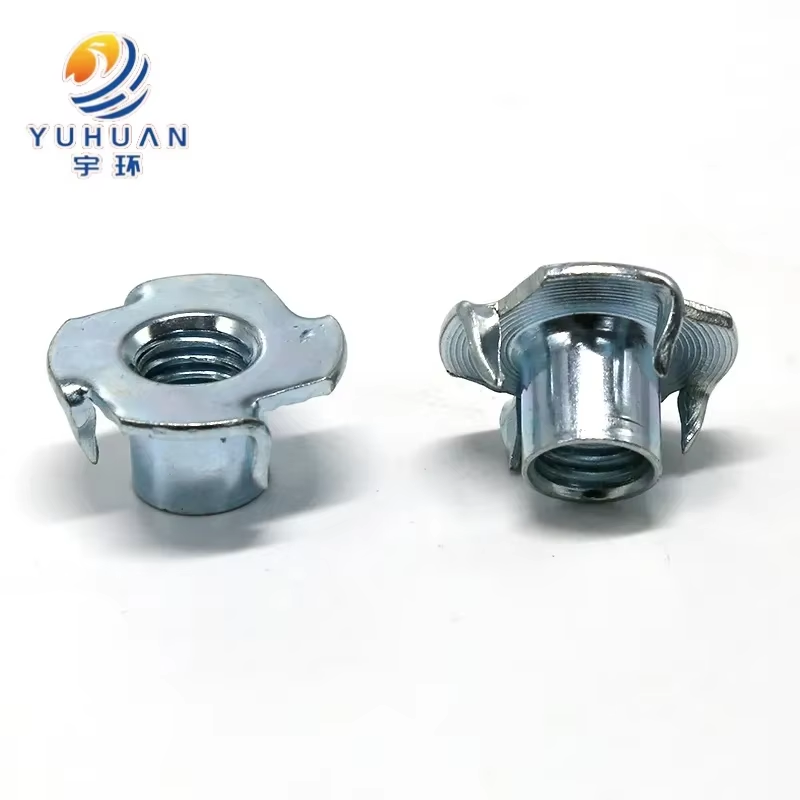
Enhanced Structural Integrity and Load-Bearing Capacity
Why Standard Threads Fail in Thin or Soft Metals
Directly tapping threads into thin aluminum or soft alloys creates inherent vulnerabilities. Threads formed in these materials typically achieve only 20–30% of the base metal’s tensile strength due to material displacement during machining. In gauges under 2mm, engagement depth is severely limited; in soft metals, axial loads induce plastic deformation. Combined, these factors concentrate stress on the first few engaged threads—accelerating stripping during vibration or thermal cycling. Unlike robust substrates, thin or low-strength metals cannot redistribute load, making failure inevitable at just 40–60% of the fastener’s rated capacity.
How Insert Nuts Distribute Stress and Resist Pull-Out
Insert nuts transform load dynamics through three interdependent mechanisms:
- Radial Force Dispersion: Serrated exteriors spread clamping pressure across a surface area 5–7× greater than tapped threads
- Material Reinforcement: High-strength steel inserts withstand up to 1,200 MPa—triple the yield strength of 5052 aluminum
- Mechanical Interlock: Knurled or flanged geometries bite into the parent material, resisting both rotational slip and axial pull-out
By converting point-loaded stress into distributed force, insert nuts increase pull-out resistance by 250–400% versus tapped holes—effectively eliminating the “cheese-cutter effect” where soft metals shear under concentrated loads.
Load Testing Data: Insert Nuts vs. Tapped Holes in 1.2mm Aluminum
Independent testing on 1.2mm 5052 aluminum panels confirms this performance advantage:
| Performance Metric | Tapped Holes | Insert Nuts | Improvement |
|---|---|---|---|
| Static Pull-Out (N) | 1,820 | 5,110 | 181% ↑ |
| Cyclic Load Cycles | 180 | 650+ | 260% ↑ |
| Stripping Torque (Nm) | 3.1 | 8.7 | 181% ↑ |
These results validate that insert nuts retain structural integrity beyond 500 assembly cycles—a critical requirement for electronics enclosures and automotive service panels where repeated access is standard practice.
Non-Destructive, One-Sided Installation with Automation Readiness
Limitations of Welding and Tapping in Enclosure Assembly
Welding thin-gauge sheet metal (<25mm) introduces heat-induced distortion—up to 0.3mm per linear centimeter—jeopardizing dimensional stability and fit. Tapped threads in aluminum or steel under 1.5mm show a 72% higher failure rate under vibration compared to reinforced alternatives. Both methods demand dual-side access, complicating robotic integration and increasing cycle time. Manual tapping further risks micro-fractures that propagate under cyclic loading, cutting enclosure service life by 30–50% in industrial environments.
Mechanical Interlock Preserves Base Material Integrity
Insert nuts install via cold-forming—eliminating thermal damage and preserving grain structure. Their radial expansion creates a mechanical interlock behind the panel, distributing clamping force across a surface area three times larger than conventional threads. This approach achieves 18 kN pull-out resistance in 1.2mm aluminum—160% greater than tapped holes—while maintaining original corrosion resistance. Robotic systems install each nut consistently in 3–5 seconds, supporting high-volume automation without secondary finishing. Crucially, the process allows infinite disassembly/reassembly without thread degradation.
Vibration Resistance, Long-Term Durability, and Easy Repairability
Preventing Thread Stripping Across Repeated Assembly Cycles
Tapped holes in sheet metal degrade rapidly with reuse: galling and micro-stripping begin after just 5–10 torque cycles, accelerating failure with each disassembly. Insert nuts eliminate this risk through engineered load distribution beyond the hole perimeter. Testing shows they withstand over 50 full assembly cycles in 1.5mm aluminum with no measurable thread wear—reducing maintenance labor and component replacement costs across product lifecycles.
Hardened Steel Insert Nuts vs. Softer Base Metal Threads
Hardened steel insert nuts exhibit ~20% higher Vickers hardness than Grade 5 fasteners, forming a durable interface that resists galling and wear even under sustained vibration. Unlike tapped threads—where damage compromises the entire panel—insert nuts are modular: only the worn component requires replacement. This design extends service life, simplifies field repairs, and avoids costly panel scrappage.
FAQ
What are insert nuts?
Insert nuts are hardware components used to reinforce and distribute load in metals, enabling greater structural integrity and load-bearing capacity.
Why are insert nuts preferred over standard threads in thin metals?
Insert nuts improve load distribution, increase pull-out resistance, and eliminate thermal damage unlike standard thread applications in thin or soft metals.
How do insert nuts compare to tapped holes in tests?
Testing shows that insert nuts have significantly better performance in terms of static pull-out, cyclic load cycles, and stripping torque compared to tapped holes.
Can insert nuts be installed with automation?
Yes, insert nuts can be installed with automation, supporting quick and consistent installation in high-volume environments.
Are repairs easier with insert nuts?
Yes, insert nuts simplify repairs by being modular, allowing for the replacement of only the worn component instead of compromising the entire panel.