
 EN
EN
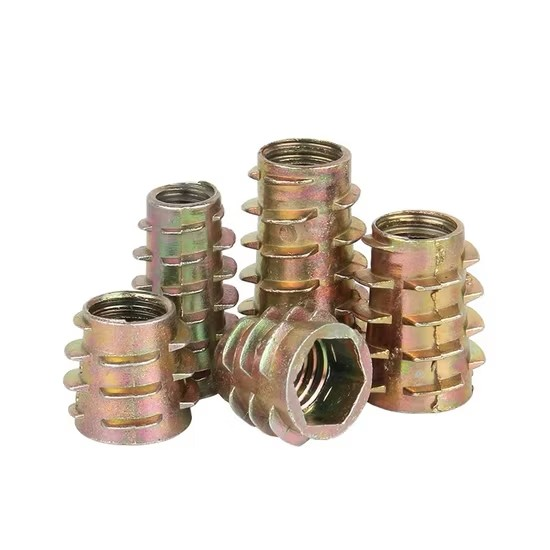
Understanding Insert Nuts and Their Role in Furniture Assembly
What Are Insert Nuts? Defining the Core Threaded Insert
Insert nuts, sometimes called threaded inserts, basically work as metal cylinders with inside threads. They're used to make strong attachment spots in different types of wood including MDF, plywood and regular solid wood. Regular screws just bite into the wood fibers when tightened, but these insert nuts have rough outside teeth that grab onto holes drilled beforehand. The way they spread out pressure across a larger surface helps prevent wood from cracking. A recent study from 2023 looked at how different fasteners affect wood surfaces, and found that wood splitting drops about two thirds when using these inserts instead of normal wood screws. Woodworkers have been noticing this benefit for years now.
How Insert Nuts Improve Upon Traditional Wood Screws
Insert nuts address key limitations of conventional wood screws, offering superior strength, durability, and reliability:
| Metric | Insert Nuts | Wood Screws | Improvement |
|---|---|---|---|
| Shear Strength | 2,200 lbs | 1,260 lbs | +75% |
| Reusable Cycles | 200+ | 35 | 5.7x |
| Humidity Failure Rate | 12% | 68% | -82% |
| Data: Furniture Engineering Consortium (2023 Comparative Study) |
Their flanged designs reduce point pressure by 34%, while steel construction withstands up to five times more installation cycles—making them ideal for furniture requiring repeated assembly or disassembly.
The Evolution of Insert Nuts in Modern Furniture Design
Insert nuts started life in the aerospace industry but have since become pretty much indispensable in today's furniture world. According to recent market research from 2024, around three out of four flat pack items now feature these special fasteners at key points like where legs attach to frames. That's way up from just over 40% back in 2018. The reason? Furniture makers are increasingly going for fastening solutions that can be used again and again while still holding everything together firmly during transport and when customers put their new purchases together at home. Makes sense really when we think about how many times these products get moved around before finding their final spot in someone's living room.
Key Applications of Insert Nuts in Furniture Construction
Securing Furniture Legs with Threaded Inserts for Wood
Insert nuts reinforce load-bearing connections in tables, chairs, and cabinets. By distributing force across their flanged base, they reduce point pressure by 34% compared to dowel pins (Ponemon 2023), minimizing wobble and joint failure. Due to this performance advantage, 78% of modern flat-pack designs use insert nuts for securing legs.
Connecting Panels Using Reusable Fastening Solutions
Cabinet side panels and shelving units benefit from the concealed, secure hold provided by insert nuts. Their ability to grip wood fibers without causing splits enables over five times more disassembly cycles than traditional screws. Designers leverage this reusability to achieve clean, hardware-free aesthetics in bookcases and entertainment centers.
Enabling Modular and Knock-Down Furniture Designs
More people moving into cities means there's growing interest in furniture that saves space and can be rearranged easily. A recent survey from IKEA found that around two thirds of millennials really care about getting furniture that fits into smaller spaces. Modular systems have become quite trendy lately because of this need. These special insert nuts let folks take apart and put together different parts like sectionals, bunk beds, even office setups without needing complicated equipment. Combine them with regular machine screws and suddenly most adjustments don't require any tools at all. Manufacturers know this works since almost nine out of ten products labeled as adaptable include this kind of feature somewhere in their design.
Case Study: Flat-Pack Furniture Relying on Insert Nut Systems
A leading European furniture brand reduced assembly-related returns by 41% after switching to brass insert nuts in its bestselling wall units. The epoxy-coated threaded inserts lowered required installation torque by 25%, preventing particleboard damage during customer assembly—a common issue with earlier screw-and-camlock systems.
Benefits of Insert Nuts for Furniture Strength and Longevity
Enhancing Joint Strength with Threaded Inserts in Woodworking
Threaded insert nuts really boost how long joints last because they spread out the mechanical stress over several contact points instead of concentrating it all in one spot. Regular wood screws tend to push force right along the grain lines of the material, which isn't great for long term stability. Tests from ASTM back this up too - these inserts keep about 90% of their holding power even after sitting there for five whole years. When working with particleboard specifically, those little flanged bases on the inserts cut down point pressure by around 40%. That makes a big difference since splitting is what usually causes joints to fail in factory made furniture pieces.
Improving Load-Bearing Capacity in Critical Connections
Steel insert nuts can handle vertical loads of over 2,200 pounds in hardwood furniture construction, which is about 74% stronger than regular wood screws according to research from the Furniture Engineering Consortium back in 2023. What makes them so strong? There are actually two things working together here. First, the internal threads grip machine screws really well, keeping everything secure. At the same time, those little teeth on the outside press against the sides of pre-drilled holes, creating extra hold. When building parts that need to withstand a lot of stress, such as chair legs or cabinet hinges, these insert nuts stand out because they resist shearing forces better than almost anything else. They stay intact even when subjected to sideways pressure reaching around 320 psi or more.
Reducing Wear and Tear in Frequently Assembled Furniture
Flat-pack furniture gains significant longevity from the reusability of insert nuts, which endure over 200 installation cycles compared to just 35 for wood screws. Because they prevent direct substrate damage during disassembly, cumulative material fatigue is minimized—resulting in 83% lower joint failure rates in modular systems, based on 2023 warranty data.
Balancing Performance and Cost: When Insert Nuts May Be Over-Engineered
Insert nuts work great when dealing with heavy loads, but they might just be overkill for those spots where stress isn't really an issue. For basic butt joints in parts of the structure that don't get much action, regular dowels or confirmat screws tend to hold up just fine while saving around 60% on materials costs as per industry standards from last year. And let's not forget about moisture problems either. We've seen these nuts fail about 12 times out of 100 in damp environments where things aren't so critical. That's why it pays to think carefully about where and how we apply them, considering both what kind of weather they'll face and exactly what job needs doing.
Material Compatibility: Using Insert Nuts in Wood, MDF, and Plywood
Why Insert Nuts Outperform Direct Threading in Low-Density Substrates
When working with engineered woods such as particleboard or MDF, the low density often makes it hard for screws to hold properly. That's where insert nuts come into play. They spread out the pressure across a bigger area instead of concentrating all that force in one spot. According to some research from 2023 on wood substrates, this actually cuts down on localized stress points by around 40 percent when compared to just threading directly into the material. The benefit? Less chance of warping or bending in materials that have a density of 0.6 grams per cubic centimeter or lower. And let's face it, this is something manufacturers run into all the time when making furniture these days since so much of what goes into production relies on these types of engineered wood products.
Optimizing Retention in Solid Wood vs. Engineered Boards
When working with solid wood materials, different types of inserts are needed for optimal results. Coarse threaded inserts tend to perform well in softer woods such as pine and cedar. On the other hand, helical inserts coated with epoxy stick about 35 percent better in moisture resistant plywood according to recent research from the Structural Woodworking Study published last year. When dealing with cross grain joints in harder woods, flanged inserts actually help fight against how wood naturally behaves in different directions. These specialized inserts resist twisting much better than regular ones, which makes them worth considering for serious woodworking projects where stability matters most.
Best Practices for Insert Nuts in MDF and Chipboard Applications
- Pre-drill pilot holes to 75% of insert height in MDF to prevent blowout
- Use steel inserts with coarse threads for chipboard (< 0.5 g/cm³ density)
- Apply heat-activated adhesives to increase pullout resistance by 2.3x in edge joints
Manufacturers widely adopt press-fit installation jigs to ensure alignment and consistency in production environments. This method reduces assembly defects by 28% in MDF-based modular furniture compared to manual insertion (2024 Mass Production Benchmarks).
Types and Installation of Insert Nuts in Furniture Production
Common Types of Insert Nuts: Flanged, Self-Tapping, T-Nuts, and Press-Fit
Four main types dominate furniture manufacturing:
- Flanged inserts distribute stress across wide areas, ideal for permanent installations.
- Self-tapping inserts form their own threads in MDF and particleboard, eliminating pre-threading steps that weaken low-density materials.
- T-nuts use prongs aligned with wood grain to achieve 37% higher lateral strength than standard designs (Ponemon 2023).
- Press-fit inserts are optimized for automated lines, where precision tooling embeds knurled models into pre-drilled holes in under two seconds.
Selecting the Right Insert Nut for Durability and Joint Design
The right insert choice really comes down to three main factors: how dense the material is, where the load will be applied, and how often it'll get used. For those tricky cross grain joints, T nuts work wonders because they dig in so deeply. But when dealing with things that rotate constantly, like those swivel chairs everyone loves at office setups, flanged inserts are the way to go since they can take all that repeated twisting without failing. And let's talk about press fit versions for a moment. These bad boys shine in temporary situations such as setting up booths at trade shows. They hold up surprisingly well through more than twenty times of taking them apart and putting them back together again without showing signs of wear and tear.
Pre-Drilling and Press-Fitting Techniques for Precision
Getting the installation right starts with selecting drill bits that match the insert's outer diameter within about 0.1mm either way. Using stepped bits makes life easier since they create those pilot holes along with built-in counterbores, which helps achieve that flat, secure fit when attaching hardware to solid wood tables. For actually setting the brass inserts into place, most professionals rely on hydraulic presses that deliver between 500 and 800 Newtons of pressure. This gentle but firm approach prevents cracking at the wood grain edges something that happens all too often when people try to drive inserts with hammers instead.
Using Adhesives to Enhance Insert Nut Retention in Soft Materials
Polyurethane adhesives boost pull-out resistance by 62% in chipboard when applied before insertion. These adhesives fill micro-gaps between knurls and substrate, forming hybrid mechanical-chemical bonds that outperform friction-only retention in MDF cabinetry.
Tools and Jigs for Efficient Insert Nut Installation in Mass Production
Automated systems equipped with vision-guided robotics verify nut orientation and seating depth within 0.2mm tolerances. Modular template jigs align 12–24 inserts simultaneously, cutting assembly time for flat-pack bookcases by 85% compared to manual processes, as documented in a 2023 furniture production benchmark study.
FAQ Section
What are insert nuts primarily used for in furniture?
Insert nuts are used to create strong attachment points in furniture, offering advantages in strength, durability, and reusability compared to traditional wood screws.
How do insert nuts improve furniture longevity?
Insert nuts distribute mechanical stress over larger areas, reducing pressure on wood fibers and minimizing joint failure, resulting in longer-lasting furniture.
Are insert nuts suitable for all types of furniture assembly?
Insert nuts are ideal for furniture requiring repeated assembly and disassembly. However, they may be over-engineered for low-stress applications where simpler connectors suffice.
What types of materials can insert nuts be used with?
Insert nuts can be used with solid wood, MDF, particleboard, and plywood, offering increased retention in engineered boards and solid wood substrates.
How have insert nuts evolved in furniture design?
Originally used in aerospace, insert nuts now play a critical role in modern furniture assembly, seen in flat-pack, modular, and knock-down furniture designs.
Table of Contents
- Understanding Insert Nuts and Their Role in Furniture Assembly
- Key Applications of Insert Nuts in Furniture Construction
- Benefits of Insert Nuts for Furniture Strength and Longevity
- Material Compatibility: Using Insert Nuts in Wood, MDF, and Plywood
-
Types and Installation of Insert Nuts in Furniture Production
- Common Types of Insert Nuts: Flanged, Self-Tapping, T-Nuts, and Press-Fit
- Selecting the Right Insert Nut for Durability and Joint Design
- Pre-Drilling and Press-Fitting Techniques for Precision
- Using Adhesives to Enhance Insert Nut Retention in Soft Materials
- Tools and Jigs for Efficient Insert Nut Installation in Mass Production
- FAQ Section